Kansas State University

search

Extension Entomology

Month: September 2025

Check emerging winter canola for fall armyworms

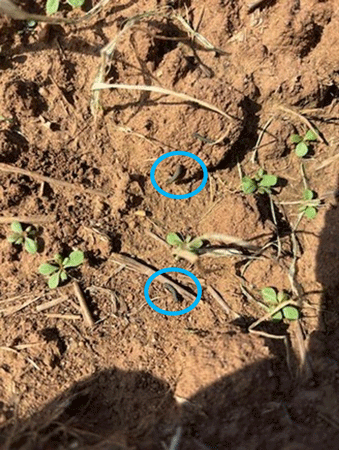
Infestations of fall armyworm are causing problems in turfgrass, pastures, and other crops this year (Figure 1). Last fall, fall armyworm feeding caused patchy losses in newly emerged winter canola fields across central and southern Kansas. Thus, it is important to frequently scout canola in the seedling stage, especially if fall armyworms are active in your area. Early detection is important because larvae can quickly overtake emerging plants. Fall armyworms often move in from road ditches or weedy areas, so begin on the field edges and work your way to the interior. Look for windowpanes on leaves, stripped plants, cut plants, and areas where plant stands appear to be thinning. Once the growing point of canola is removed, the plant is lost and will not recover.
A close up of a plantAI-generated content may be incorrect.

Figure 1. Fall armyworm feeding on volunteer wheat in a fallow field. Photo by Cody Swinehart, Kingman County.

The current crop of larvae is the second generation, and historically, there have been only two generations per year in Kansas. These larvae are close to maturity and approaching pupation, so they should be about finished feeding. The second-generation moths that emerge from these larvae will return south for the winter. However, the first generation occurred very early in a warm spring, so the second generation, which is less synchronous in development, also began earlier. If some of the early-matured second-generation moths start laying eggs, a partial third generation may be possible this year. It is unlikely any of these larvae would get large enough to mature, but they could still cause localized damage. The cue for southerly migration is shorter day length, with some interaction with temperature, and these conditions may not have been experienced by second-generation moths that emerged in August.

One way to minimize this risk would be to plant later, toward the end of the planting window. However, this risk assessment is based on our knowledge of fall armyworm biology and behavior and is entirely speculative – there is no historical reference. Delayed planting of winter canola has other risks, including the inability to develop the necessary top growth for overwintering.

Although no efficacy data exist for winter canola, seed treatments with chlorantraniliprole, cyantraniliprole, or imidacloprid have provided up to two weeks of control of fall armyworm on emerging corn. However, if feeding pressure is heavy on small seedlings, seed treatments may not prevent stand losses. Several common insecticides are labelled for fall armyworm control if needed before or after canola emergence (Table 1).
Table 1. Insecticide options for controlling fall armyworm in winter canola.

Chemical Name Trade Name Class Rate (fl oz/a)
Bifenthrin (numerous products) Brigade 2EC 3a 2.1-2.6
Bifenthrin plus zeta-cy Steed 3a 2.5-3.5
Bifenthrin plus zeta-cy Hero 3a 2.6-5.5
Gamma-cyhalothrin Proaxis 3a 1.92-3.84
Gamma-cyhalothrin Declare 3a 0.77-1.54
Lambda-cyhalothrin Warrior II w/Zeon Tech 3a 0.96-1.92
Lambda-cyhalothrin plus chlorantraniliprole Besiege 3a+28 5.0-10.0
Zeta-cypermethrin Mustang Maxx 3a 4.0


For more information on insects important to canola, see the “Great Plains Canola Production Handbook” available at https://www.bookstore.ksre.ksu.edu/pubs/mf2734.pdf.

The use of trade names is for clarity to readers and does not imply endorsement of a particular product, nor does exclusion imply non-approval. Always consult the herbicide label for the most current use requirements.


Mike Stamm, Canola Breeder
mjstamm@ksu.edu

J.P. Michaud, Entomologist, Agricultural Research Center – Hays
jpmi@ksu.edu

Anthony Zukoff, Instructor of Entomology, Southwest Research-Extension Center – Garden City
azukoff@ksu.edu

They may be spooky, but spiders are beneficial to the garden

By K-State Extension news service.

MANHATTAN, Kan. – Many people view spiders as pests, and the fear of spiders is one of the most common phobias among Americans. However, spiders are predators that feed on insect pests in gardens and landscapes.

Kansas State University entomology expert Raymond Cloyd says that spiders feed on insects that may damage ornamental and vegetable crops. Consequently, they should be left alone and encouraged to take up residence in gardens and landscapes.

“There are two common species of garden spiders in Kansas that are active during the day,” Cloyd said. “They are the yellow garden spider and banded garden spider.”

The yellow garden spider has a black abdomen with yellow markings and black legs with a yellow or red band, Cloyd said. The banded garden spider has continuous bands across the abdomen and legs, alternating white and dark with orange and black bands on the legs. Both spiders create large webs in gardens and landscapes.

Garden spiders rely on vibrations that move through the web to indicate that prey have been captured.

Cloyd recommends leaving garden spiders alone because they are beneficial and are not harmful to humans.

Cloyd and his colleagues in K-State’s Department of Entomology produce a weekly Extension Entomology Newsletter with information on managing insect and mite pests of landscapes and gardens.

Interested persons can subscribe to the free newsletter, as well as send their insect-related questions to Cloyd at rcloyd@ksu.edu, or contact your local K-State Research and Extension office.

More information: Raymond Cloyd, rcloyd@ksu.edu

Related: K-State Horticulture Newsletter | Kansas Garden Guide | Horticulture Resource Center

Agriculture Today: Lawn and Garden Pests

Listen to Episode 2015 of Agriculture Today where horticultural entomologist, Raymond Cloyd discusses fall armyworms, mimosa webworms, cicada killers and grubs.

Agriculture Today is a daily program hosted by K‑State Research and Extension and distributed to radio stations throughout the state and region. K-State agricultural specialists and other experts examine agricultural issues facing Kansas and the nation.

Related:

Tips for managing armyworms

Monitoring for armyworms is the first step to managing infestations.

By Madeline DrakeK-State Extension news service

MANHATTAN, Kan. — As recent harvests and scouting reports may indicate, armyworms and fall armyworms seem to become a more serious problem for Kansas farmers each year.

For those who may have experienced problems with the insects this year, Kansas State University crop entomologist Jeff Whitworth and agronomist Tina Sullivan say it’s a good idea to understand the issue and develop tactics for tackling future infestations.

Whitworth said the start of any good management program involves early scouting.

“Start by periodically monitoring whatever the vulnerable area you are worried about is to detect any infestation while the ‘worms’ are still small and have not yet caused much damage,” Whitworth said.

When scouting, it’s important to know the thresholds that signal when action should be taken.

“Generalized thresholds are four to five larvae per square foot,” Sullivan said.

Usually two to four generations of armyworms per growing season means monitoring should continue until temperatures turn cold, approximately mid-20 degrees Farenheit for two hours, Whitworth said.

While armyworm infestations cannot be totally prevented, Whitworth recommends traps available to deploy around target areas.

“These traps will not control or prevent an infestation, but they can catch the moths to indicate when these adults are actually flying and thus depositing eggs,” he said.

“Armyworms have chewing mouth parts, thus they bite and chew their food, most often a grass crop like sorghum, brome, wheat, fescue or other,” Whitworth said. “Armyworms eat off the above ground green portion of whatever grass the moth deposited the eggs on.”

Once a field is infested with armyworms, there are some options for eradicating them with insecticides.

“There are several insecticides labeled for armyworm control. Most work quite well if utilized according to the label,” Whitworth said.

Sullivan added that forage stands are especially vulnerable.

“Our forage stands tend to be the most damaged year after year. The cost of insecticide applications is often more economical compared to the seed and planting costs of re-establishing any of our forage fields – tame or native,” she said.

Maintaining a healthy forage stand, Sullivan noted, comes down to good fertility, timely grazing and cutting schedules, and awareness of weather conditions.

More information on crop production and other agriculture-related topics is available at local extension offices in Kansas.

See original posting on K-State Research and Extension News.

More information:
Jeff Whitworth, 785-532-5656, jwhitwor@ksu.edu
Tina Sullivan, tsullivan@ksu.edu

Related: Facts & Information on Crop Pests in Kansas | Armyworms

Catalpa Caterpillar/Catalpa Sphinx

By Raymond Cloyd, K-State extension horticultural and plant protection entomologist.

The catalpa caterpillar or catalpa sphinx, Ceratomia catalpae, is an insect pest native to the eastern USA that only feeds on catalpa trees, including Catalpa bignonioides and C. speciosa. This article describes the biology, damage, and management of the catalpa caterpillar.

Figure 1. Catalpa sphinx adult (Ken Childs).

Biology

Adults are brown (Figure 1) and have a 2.5 to 3.7 inch (6.3 to 9.3 centimeter) wingspan. Adults are present from spring through fall. After mating, females lay clusters of up to 1,000 eggs on the underside of leaves. Young catalpa caterpillars that emerge (eclose) from eggs are white with black spots on the body (Figure 2). Older caterpillars are approximately 3.0 inches (7.6 centimeters) long, with a black head and black stripe that extends the length of the back (Figure 3).

Figure 2. Young catalpa caterpillars (Andy Reago and Chrissy McClarren).
Figure 3. Older catalpa caterpillars.

There are also yellow stripes, with black vertical bands, that extend along both sides of the body (Figure 4). Some caterpillars will have a row of black spots along the back but will not have a black stripe. There are five instars (stages between each molt). Caterpillars are present from spring to late fall. Caterpillars eventually move to the base of a catalpa tree and enter the soil to pupate. They overwinter as pupae in the soil at a depth of 2 to 3 inches (5.0 to 7.6 centimeters). There may be up to three generations per year in Kansas.

Figure 4. Older catalpa caterpillar (Raymond Cloyd).

Catalpa trees contain iridoid glycosides, which are compounds that serve as antifeedants for generalist insect species or attractants for specialist insect species. The presence of iridoid glycosides, also called catalposides, may be why the catalpa caterpillar only feeds on catalpa trees. The iridoid glycosides, which are stored in the hemolymph, are sequestered by catalpa caterpillars, resulting in their being unpalatable to predators.

Damage

Young caterpillars feed initially in groups and then disperse among a tree. Caterpillars remove leaf tissue, except for the main veins. Extensive populations of older caterpillars can completely defoliate a catalpa tree (Figures 5 and 6).

Figure 5. Catalpa tree feb upon by catalpa caterpillars (Raymond Cloyd).
Figure 6. Catalpa tree fed upon by catalpa caterpilars (Raymond Cloyd).

Management

  1. Remove leaves with eggs and caterpillars from trees and place them into a bucket with soapy water.
  2. Ensure that catalpa trees are properly watered and fertilized so they can withstand feeding by catalpa caterpillars and produce new leaves later in the growing season.
  3. Apply a contact or stomach poison insecticide when young caterpillars are present in the spring.
  4. Replace young catalpa trees that are completely defoliated with a different type of tree.

Caterpillars are susceptible to attack by a parasitoid, Cotesia congregata. A catalpa caterpillar that has been attacked by the parasitoid will be covered with white cocoons (Figure 7).

Figure 7. Catalpa caterpillar with white cocoons on the body (Bill Duncan)