Kansas State University

search

Extension Entomology

Month: October 2025

Upcoming Commercial Pesticide Applicator Education

The K-State Research and Extension Pesticide Safety and Integrated Pest Management (IPM) program at Kansas State University provides recertification training credits to current certified commercial applicators, in cooperation with the Kansas Department of Agriculture (KDA) Pesticide and Fertilizer Program.

Want to be notified of our training opportunities? Sign up to receive an email!

See opportunities below.

Date of Course Course Schedule
Location Register Categories
October 28, 2025 Recertification Training: Aquatic Pest Control Manhattan, KS Online Registration 5, core hour
November 17, 2025 Recertification Training: Ag Wildlife Damage Pest Control McPherson, KS Online Registration 1C, core hour
November 18, 2025 Recertification Training: Right-of-Way, Industrial & Noxious Weed Hutchinson,
KS
Online
Registration
6, 7C, 9A, core hour
November 24, 2025 Recertification Training: Ornamental and Turf Pest Control Virtual Online Registration 3A, 3B -1 Hour
December 8, 2025 Recertification Training: Public Health and Structural Virtual Online Registration 7D, 7D, 8, core hour

Visit the K-State Research and Extension Pesticide Safety and Integrated Pest Management Program Commerical Applicators page for more information.

More information: Frannie Miller, fmiller@ksu.edu

Related: K-State Research and Extension Pesticide Safety and Integrated Pest Management Program

Asian Longhorned Tick Identified on Dog in Kansas

Asian longhorn tick

By Kansas Department of Agriculture.

The Kansas Department of Health and Environment and the Kansas Department of Agriculture are alerting the public to the first known occurrence of the Asian longhorned tick (ALHT), Haemaphysalis longicornis, in Kansas. KDHE identified the ALHT after it was found on a dog in Franklin County last week.

ALHT is an exotic, invasive tick species that was first identified in the United States in New Jersey in 2017. Since then, it has spread westward across the U.S. and, according to the U.S. Department of Agriculture, has now been documented in 21 states, with Kansas being the most recent (https://www.aphis.usda.gov/livestock-poultry-disease/cattle/ticks/asian-longhorned/asian-longhorned-tick-what-you-need-know).

“We have been monitoring the spread of the Asian longhorned tick, especially since it was confirmed in neighboring states,” said Kansas Animal Health Commissioner Dr. Justin Smith. “Now that it has been identified in Kansas, we have been in contact with accredited veterinarians across the state to remind them to be alert for this tick and to ensure they understand the risks.”

This prolific tick, which can reproduce without the need for a male tick, has both human and animal health implications. In 2019, an ALHT in Virginia was found to be infected with Bourbon virus, while Connecticut recently identified an ALHT infected with ehrlichiosis, both of which are tick-borne diseases that occur in Kansas but are currently transmitted by the Lone Star tick.

“We’re still learning about this tick and the ecologic role that it currently plays and may play in the future in terms of disease transmission to humans” Dr. Erin Petro, KDHE State Public Health Veterinarian, said. “While the human health implications are uncertain, this tick has serious implications for animal health.”

The ALHT can cause extreme infestations on affected animals, sometimes leading to severe anemia or even exsanguination. Beyond the physical threat, the ALHT also transmits the cattle parasite Theileria orientalis Ikeda strain, which causes bovine theileriosis.

In 2024, KDHE piloted a program to create a passive tick surveillance network of veterinary clinics throughout the state. Through this program, participating clinics submit tick samples from animals in their care to KDHE for identification. This program has been successful in providing information on where various ticks are found across the state and has been especially useful in under-surveyed areas. One of these partners submitted a routine sample which was later identified as ALHT by KDHE and confirmed by the USDA. In both humans and animals, tick bite prevention is key.

To reduce the risk of disease, follow these precautions:

  • Be aware of where ticks are found and using preventive measures when in grassy, brushy, or wooded areas.
  • Dress preventively by wearing long pants tucked into socks and shirt tucked into pants.
  • Treat clothing and gear with permethrin.
  • Use an EPA-approved repellent such as DEET, picaridin, or oil of lemon eucalyptus (OLE) when enjoying the outdoors or being in a tick habitat.
  • After coming indoors, perform a thorough tick check, being sure to focus on the waistband, under the arms, in and around the ears, inside the belly button, back of knees, and in and around the hair.
  • Check pets for ticks, especially around the tail, between the back legs, under the front legs, between the toes, in and around the ears, around the eyes, and under the collar.
  • Shower soon after being in a tick habitat or engaging in outdoor activities. This will help remove any unattached ticks and identify any attached ticks.
  • To remove attached ticks, use a pair of fine-tipped tweezers, grasp the tick near the skin, and apply gentle traction strait outwards until the tick is removed.
  • Help prevent tick-borne diseases and tick infestations on pets by consulting with your veterinarian on use of a veterinary-approved flea and tick preventative.
  • More information on tick bite prevention and controlling ticks in your environment can be found at Preventing Tick Bites | Ticks | CDC.

For more information on the Asian longhorned tick including where it has been found in the U.S., visit the USDA Longhorned Tick Story Map at https://www.aphis.usda.gov/livestock-poultry-disease/cattle/ticks/asian-longhorned/asian-longhorned-tick-what-you-need-know. To find more information on other ticks, their geographic distributions, and the diseases they transmit in Kansas, visit KDHE’s Tickborne Disease Data Stories at https://maps.kdhe.state.ks.us/kstbdhome/.


Dr. Cassandra Olds specializes in veterinary entomology and works with livestock producers, veterinarians and others through her extension efforts. For contact info and her lab: https://entomology.k-state.edu/about/people/faculty/Olds-Cassandra.html

Photo provided for the cover is courtesy of Joshua Jackson, entomology graduate student in the Olds Veterinary Entomology Lab.

Common spiders in Kansas likely to go into hiding soon

black widow

By K-State Extension news service.

Spiders are likely to be gone by Halloween. Whitworth says four spider species common to Kansas are likely to be in hiding within the next few weeks.

Two species commonly found in the home that are of most concern to humans because of their venom – the brown recluse and black widow – are ready to go into winter hibernation. Whitworth said those two species are rarely seen from mid-October to mid-March.

The brown recluse is identified by a signature dark line that resembles a violin on its back, with the neck of the violin pointing to the rear of the spider. The bite of a brown recluse releases a hemotoxin that affects a person’s blood cells. A bite from a brown recluse may require medical attention.

“The brown recluse is nocturnal, thus they are most active at night when they crawl around searching for food,” Whitworth said. “As daylight returns, they crawl into any dark place close by, which is often in a shoe or clothing, if left on the floor. That is the reason that most bites occur; the spider is threatened when you put the item on.”

The adult female black widow is more elegant looking, typically a very shiny black with a reddish, hourglass shaped mark on their abdomen. The bite of a black widow releases a neurotoxin that affects the nervous systems of humans and animals.

“The black widows are web builders,” Whitworth said. “Thus, they are usually encountered in some out-of-the-way corner of a garage, shed, basement or similar place. They usually are not out wondering like a brown recluse.”

Two less-venomous spiders more common in farm fields or open areas include the orb spider and the garden spider.

The orb spider is typically a big, brown, round spider that weaves intricate webs.

“You will often see webbing, but not the spider,” Whitworth said. “The webbing catches insects, and then the spider comes out in the evening to feed on what they’ve caught” and repair the web, if needed.

Another common field spider, the garden spider, also is very large, and typically dark green or black and yellow with long legs. Farmers often run into garden spiders when walking between fields because they’ll use corn or sorghum or large weeds to build their webs, “and by this time of year, most spiders are at their largest and thus have constructed large webs for catching prey,” according to Whitworth.

“If they feel threatened in their web, they will vibrate the web, but if that doesn’t work, they usually drop to the ground and hide,” he said.

But like the brown recluse and black widow, orb spiders and garden spiders are likely to be out of sight by the time the scariest holiday of the year rolls around.

“We are just about to run out of being scared by spiders, and just before Halloween,” Whitworth said, “because the adult field spiders are going to lay their eggs and then go away. The brown recluse and black widow are going into hibernation and won’t be back until March or April.”

Whitworth said that even though the brown recluse and black widow are better known to be dangerous, “all spiders are venomous.”

“Most spider bites don’t affect humans too much, but you just never know,” he said. “I always caution people not to play with spiders.”

More information: Jeff Whitworth, 785-532-2371, jwhitwor@ksu.edu

Related: Brown Recluse Spiders | Kansas structural Pests

Crickets coming out of crops and into homes

Female field cricket

Listen to Episode 2030 of Agriculture Today where Jeff Whitworth, K-State crop entomologist, breaks down the common crickets in Kansas and how to help stop them from coming into homes.

Agriculture Today is a daily program hosted by K‑State Research and Extension and distributed to radio stations throughout the state and region. K-State agricultural specialists and other experts examine agricultural issues facing Kansas and the nation.

Read MF3291 Household Pests of Kansas to learn more about common household pests in Kansas and management strategies.

Turfgrass insect showing up in large numbers

By Pat Melgares, K-State Research and Extension news service.

MANHATTAN, Kan. — An insect that is showing up in large numbers on sidewalks, under trees and around grassy areas in Kansas is not a major threat to turfgrass—but they are a nuisance, said Kansas State University entomologist Raymond Cloyd.

K-State entomologist Raymond Cloyd said the larvae of the green June beetle has been showing up in large numbers in Kansas this fall.

Green June beetle larvae (grubs) are approximately two inches in length. The larvae are prevalent in large numbers near managed and unmanaged grassy areas. High temperatures and abundant moisture, such as what many parts of Kansas have experienced recently, enhance their presence.

“The larvae are not going to cause substantial damage to your turfgrass,” Cloyd said, “but the larvae are a nuisance.”

At one location near K-State’s Manhattan campus, Cloyd said he collected about 20 larvae from the sidewalk and on the soil in less than three minutes. At the same location, a worker had a bucket containing more than 50 larvae.

Cloyd said green June beetle larvae are common this time of year, but he admits that he has received more email inquiries from Kansas residents about the larvae this year.

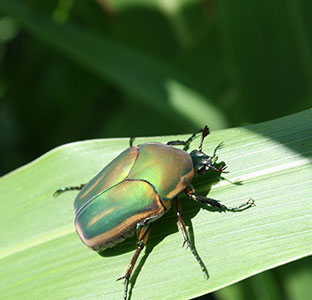
Green June beetle adult on green leaf
Green June beetle adult

Green June beetle adults are present during the summer months and fly erratically, occasionally bumping into people and objects. When flying, adults produce a sound like bumble bees.

The larvae are present from late summer to early fall, and feed near the soil surface in thatch or on grass clippings. They sometimes can be found in pools, basements and garages. Larvae can be distinguished from other turfgrass insect pests by their tendency to crawl on their backs when moving around.

Green June beetle larvae cause less damage to turfgrass than other insect pests, but they can cause some damage by creating soil mounds. Birds, moles and skunks damage turfgrass when foraging for green June beetle larvae.

Cloyd said it is too late to apply insecticides to manage or kill the larvae, which will eventually move deeper into soil and overwinter as mature larvae.

“The Scoliid wasp, Scolia dubia, is a naturally occurring parasitoid of the green June beetle larvae located in the soil,” Cloyd said. “Females fly just above turfgrass infested with green June beetle larvae. A female locates a green June beetle larva in the soil and uses her ovipositor (egg laying) device to paralyze the larva.”

“If you have large numbers of larvae on your sidewalks or other areas of the yard, you can collect them and place into a container of soapy water to kill them.”

Cloyd has authored a publication titled, Green June Beetle: Insect Pest of Turfgrass, which is available online from the K-State Extension bookstore.

More information also may be available at local extension offices in Kansas.