Kansas State University

search

Extension Entomology

Category: Livestock

Video: Invasive insects coming to Kansas

K-State Research and Extension news service

In this video, K-State Research and Extension veterinary entomologist Cassandra Olds details a pair of invasive insects that could threaten Kansas livestock herds: the Asian longhorn tick and the New World screwworm fly.

The Asian longhorn tick was recently detected in Kansas. The species reproduces without mating, allowing a single tick to establish a population.

The New Word screwworm fly has been moving steadily northward, but has not yet reached Kansas. The fly spreads easily as adult insects travel or as infested animals are relocated.

“How did they get here in the first place?” Olds asks. “Sometimes, we’re at fault, sometimes it’s just the way things are. The Asian longhorn tick probably came across on infested animals or wildlife. Sometimes our dogs go running through fields and they pick up ticks and bring them home.”

View the full video at https://www.youtube.com/watch?v=4XEZbMmN3DQ

Video by:
Dan Donnert, 785-532-5804, ddonnert@ksu.edu

For more information:
Cassandra Olds, colds@ksu.edu

Kansas State University is committed to providing equal access opportunity and reasonable accommodation to campus programs and services for faculty, staff and students. If you require accommodation to view or hear a video live stream or archive, please submit a request for accommodation. Students should make their request to the Student Access Center. All others should request accommodation through Human Capital Services.

Asian Longhorned Tick Identified on Dog in Kansas

Asian longhorn tick

By Kansas Department of Agriculture.

The Kansas Department of Health and Environment and the Kansas Department of Agriculture are alerting the public to the first known occurrence of the Asian longhorned tick (ALHT), Haemaphysalis longicornis, in Kansas. KDHE identified the ALHT after it was found on a dog in Franklin County last week.

ALHT is an exotic, invasive tick species that was first identified in the United States in New Jersey in 2017. Since then, it has spread westward across the U.S. and, according to the U.S. Department of Agriculture, has now been documented in 21 states, with Kansas being the most recent (https://www.aphis.usda.gov/livestock-poultry-disease/cattle/ticks/asian-longhorned/asian-longhorned-tick-what-you-need-know).

“We have been monitoring the spread of the Asian longhorned tick, especially since it was confirmed in neighboring states,” said Kansas Animal Health Commissioner Dr. Justin Smith. “Now that it has been identified in Kansas, we have been in contact with accredited veterinarians across the state to remind them to be alert for this tick and to ensure they understand the risks.”

This prolific tick, which can reproduce without the need for a male tick, has both human and animal health implications. In 2019, an ALHT in Virginia was found to be infected with Bourbon virus, while Connecticut recently identified an ALHT infected with ehrlichiosis, both of which are tick-borne diseases that occur in Kansas but are currently transmitted by the Lone Star tick.

“We’re still learning about this tick and the ecologic role that it currently plays and may play in the future in terms of disease transmission to humans” Dr. Erin Petro, KDHE State Public Health Veterinarian, said. “While the human health implications are uncertain, this tick has serious implications for animal health.”

The ALHT can cause extreme infestations on affected animals, sometimes leading to severe anemia or even exsanguination. Beyond the physical threat, the ALHT also transmits the cattle parasite Theileria orientalis Ikeda strain, which causes bovine theileriosis.

In 2024, KDHE piloted a program to create a passive tick surveillance network of veterinary clinics throughout the state. Through this program, participating clinics submit tick samples from animals in their care to KDHE for identification. This program has been successful in providing information on where various ticks are found across the state and has been especially useful in under-surveyed areas. One of these partners submitted a routine sample which was later identified as ALHT by KDHE and confirmed by the USDA. In both humans and animals, tick bite prevention is key.

To reduce the risk of disease, follow these precautions:

  • Be aware of where ticks are found and using preventive measures when in grassy, brushy, or wooded areas.
  • Dress preventively by wearing long pants tucked into socks and shirt tucked into pants.
  • Treat clothing and gear with permethrin.
  • Use an EPA-approved repellent such as DEET, picaridin, or oil of lemon eucalyptus (OLE) when enjoying the outdoors or being in a tick habitat.
  • After coming indoors, perform a thorough tick check, being sure to focus on the waistband, under the arms, in and around the ears, inside the belly button, back of knees, and in and around the hair.
  • Check pets for ticks, especially around the tail, between the back legs, under the front legs, between the toes, in and around the ears, around the eyes, and under the collar.
  • Shower soon after being in a tick habitat or engaging in outdoor activities. This will help remove any unattached ticks and identify any attached ticks.
  • To remove attached ticks, use a pair of fine-tipped tweezers, grasp the tick near the skin, and apply gentle traction strait outwards until the tick is removed.
  • Help prevent tick-borne diseases and tick infestations on pets by consulting with your veterinarian on use of a veterinary-approved flea and tick preventative.
  • More information on tick bite prevention and controlling ticks in your environment can be found at Preventing Tick Bites | Ticks | CDC.

For more information on the Asian longhorned tick including where it has been found in the U.S., visit the USDA Longhorned Tick Story Map at https://www.aphis.usda.gov/livestock-poultry-disease/cattle/ticks/asian-longhorned/asian-longhorned-tick-what-you-need-know. To find more information on other ticks, their geographic distributions, and the diseases they transmit in Kansas, visit KDHE’s Tickborne Disease Data Stories at https://maps.kdhe.state.ks.us/kstbdhome/.


Dr. Cassandra Olds specializes in veterinary entomology and works with livestock producers, veterinarians and others through her extension efforts. For contact info and her lab: https://entomology.k-state.edu/about/people/faculty/Olds-Cassandra.html

Photo provided for the cover is courtesy of Joshua Jackson, entomology graduate student in the Olds Veterinary Entomology Lab.

Does Kansas need to worry about the New World screwworm outbreak in Mexico?

Adult New World Screwworm fly

Cassandra Olds, K-State extension livestock entomologist.

MANHATTAN, Kan.Spurred on by the New World screwworm (NWS) outbreak in Mexico, fears about a reintroduction into the United States are mounting. Here we discuss the risk to Kansas cattle and what to do if you suspect an outbreak.

NWS was present in Kansas prior to its eradication from the US in the 1960s. Extension reports compiled by EG Kelly (K-State Extension entomologist from 1918-1949) recorded incidents of NWS infestations in cattle and sheep. Interestingly, he listed them as less impactful than cattle grubs, biting flies, and cattle lice. Prior to eradication, NWS populations would migrate northwards during the spring and summer from overwintering areas in southern Texas, New Mexico, Arizona, California and parts of Florida. Kansas winter temperatures were (and still are) too cold to support year-round fly populations.

For NWS to become a significant problem in Kansas, it will have to first reestablish in southern states. Currently, the primary risk of introduction into Kansas is through the movement of infested animals from outbreak regions during the spring and summer months. Animal movement from Mexico is currently suspended to reduce this risk, however wildlife contributes significantly to the spread of infection, even if domestic animal movement is restricted. To date, there have been no cases of infestation in the US related to the Mexico outbreak. The USDA has announced their NWS Domestic Readiness and Response Policy Initiative which relies on active fly surveillance, restricting animal movement and release of sterile flies, all proven to be the most effective method of control. An additional fly rearing facility in Texas is expected to be operational by the end of 2025 to increase production of sterile flies. NWS females only mate once, while males mate multiple times. By releasing sterile males into the environment, they mate with wild females who then lay non-viable eggs. By out competing wild males, sterile males will reduce the population over time, eventually leading to eradication of the population.

To reduce risk of an outbreak, inspect any animals arriving from out of state for wounds infested with maggots. If maggots are found infesting a wound of any animal, contact the Kansas Animal Health Commissioner and APHIS Area Veterinary Office to co-ordinate sample collection and identification. Maggots should be collected from deep within the wound and preserved in 70% alcohol. As the NWS is attracted to the smell of wounds, inspect and clean any wounds to reduce the risk of an infestation. Detailed information on the fly life cycle, wound care and reporting suspected infestations can be found here. Updates on the current outbreak can be found here, and more information on the USDA response plan can be accessed here.

Contact information for sample collection:

Animal Health Commissioner: Dr. Justin Smith, 785-564-6601

Assistant Animal Health Commissioner: Dr. Sara McReynolds, 785-564-6792

APHIS Area Veterinarian Office: 785-228-6565

Fall brings horse bot flies

–by Cassandra Olds, Livestock and Veterinary Entomology


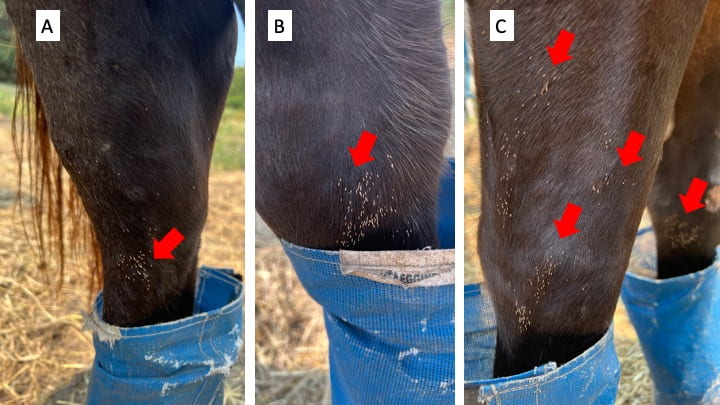
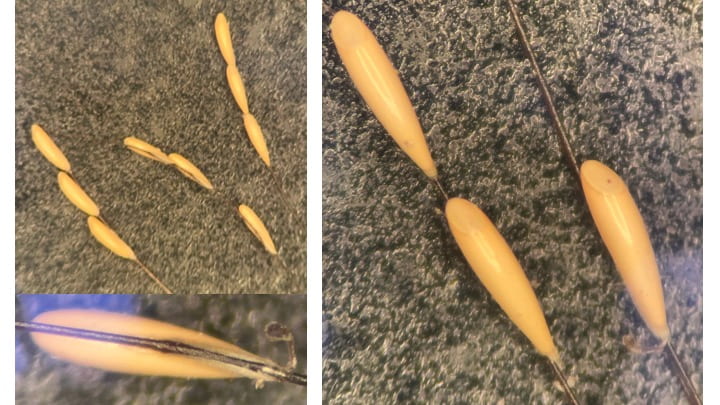
Horse owners may be noticing the appearance of small yellow eggs laid on the legs of their horses. All four legs can be targeted but higher egg numbers are normally observed on the front legs (Figure 1). These eggs are laid by the horse bot fly, Gasterophilus intestinalis (DeGeer) with each female laying between 150 and 1000 eggs! Eggs are glued to the hair shaft and multiple eggs can be laid on a single hair strand (Figure 2).


Figure 1: Horse bot fly eggs laid in batches attached to hair on the hind (A) and front (B and C) legs of a horse. This horse had well over 700 eggs in total.


Figure 2: Removed horse bot fly eggs still attached to horse hair. Multiple eggs can be laid on a single hair strand. These eggs were removed prior to hatching as the egg casing remains intact and closed.


Eggs hatch within 10 days, stimulated by horse licking and increased humidity. Larvae enter the horse mouth and imbed in the tissue where they remain for roughly 28 days. After molting, second stage larvae exit mouth tissues and are swallowed, thereby moving the stomach. The larva can remain in the stomach for 9-12 months where it molts into the third and final larval stage. After maturing the third instar detaches from the digestive tract and is passed out in the feces. The larva will burrow into the soil and pupate where it will remain for 1-2 months. As horses tend to create manure piles, the number of flies pupating in an area can become significant. Adult flies can cause significant fly worry, adverse reactions to flies can result in horses injuring themselves trying to escape from attack. Under high numbers, reduced grazing can result in weight loss.  Significant mouth irritation can occur when first instar larvae burrow into oral tissue and although horses can tolerate low levels of stomach parasitism, large numbers can cause blockages, colic and reduced nutrient uptake.


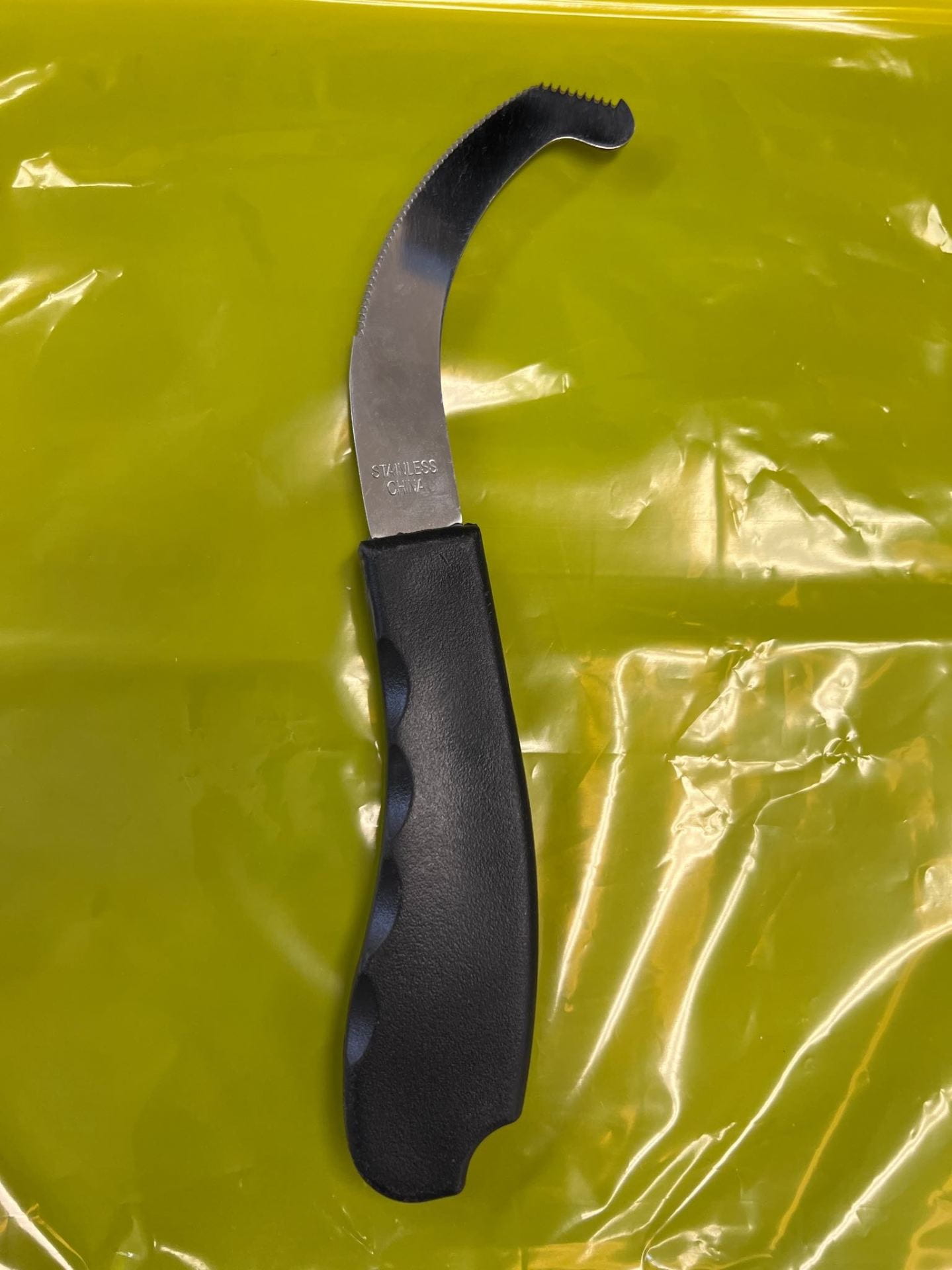
Control can be achieved through a combination of sanitation, egg removal and correctly timed oral dewormer. Removing eggs immediately will significantly reduce the risk of a horse consuming larvae and initiating the infestation cycle. A simple and inexpensive ($3-7) bot egg knife (Figure 3) can be used to physically remove eggs from the legs.


Figure 3: A bot fly knife can be used to remove bot fly eggs from horse hair by scraping downwards with the direction of hair growth.


Deworming one month after eggs were noticed will kill any second instar larvae that may have been consumed and now reside in the stomach. A second round of dewormer can be administered 6 months after the first dose to remove any third instar larvae. Removing manure piles from the site can reduce the number of adult flies emerging.


Biting Flies (horn, stable, horse and deer flies)

–by Cassandra Olds — Livestock and Veterinary Entomology


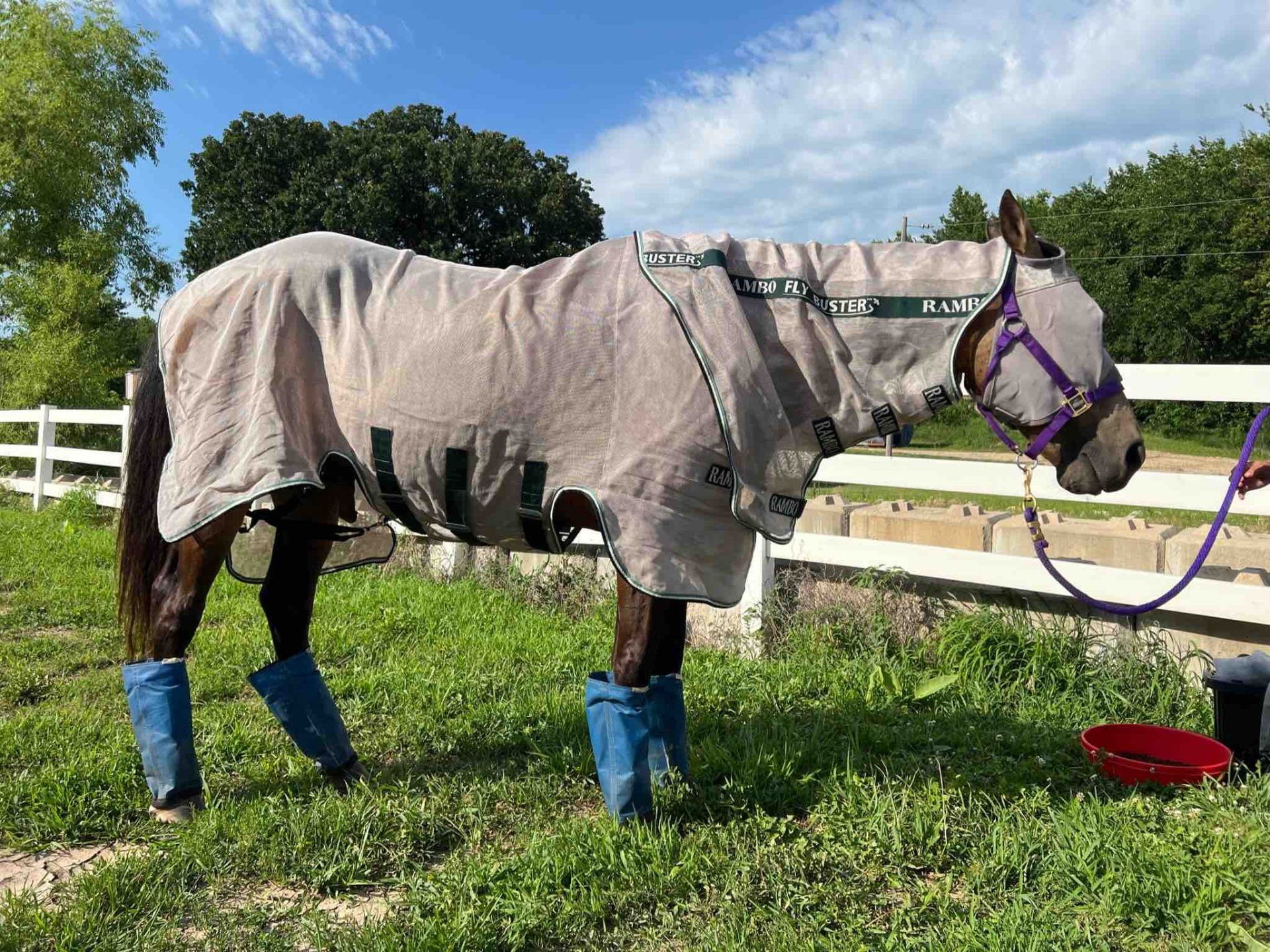
Biting flies (horn, stable, horse and deer flies) are a common problem encountered by horses. Animals under attack can exhibit a number of fly worry behaviors including skin twitching, leg stamping, tail swishing and general agitation. Horses trying to escape from flies can stampede and injure themselves so effective fly control is essential! Although pyrethroid based sprays can kill flies on horses, a study carried out this summer determined that their repellant effects wore off within 4 hours. In contrast, physical barrier protection through a full body fly sheet, fly boots and fly mask, reduced fly worry behavior by 80-90% and was sustained throughout the day. Physical barriers inhibit the ability of the fly to reach the host skin and take a blood meal, not only does this reduce fly worry but also reduces the risk of pathogen transmission.

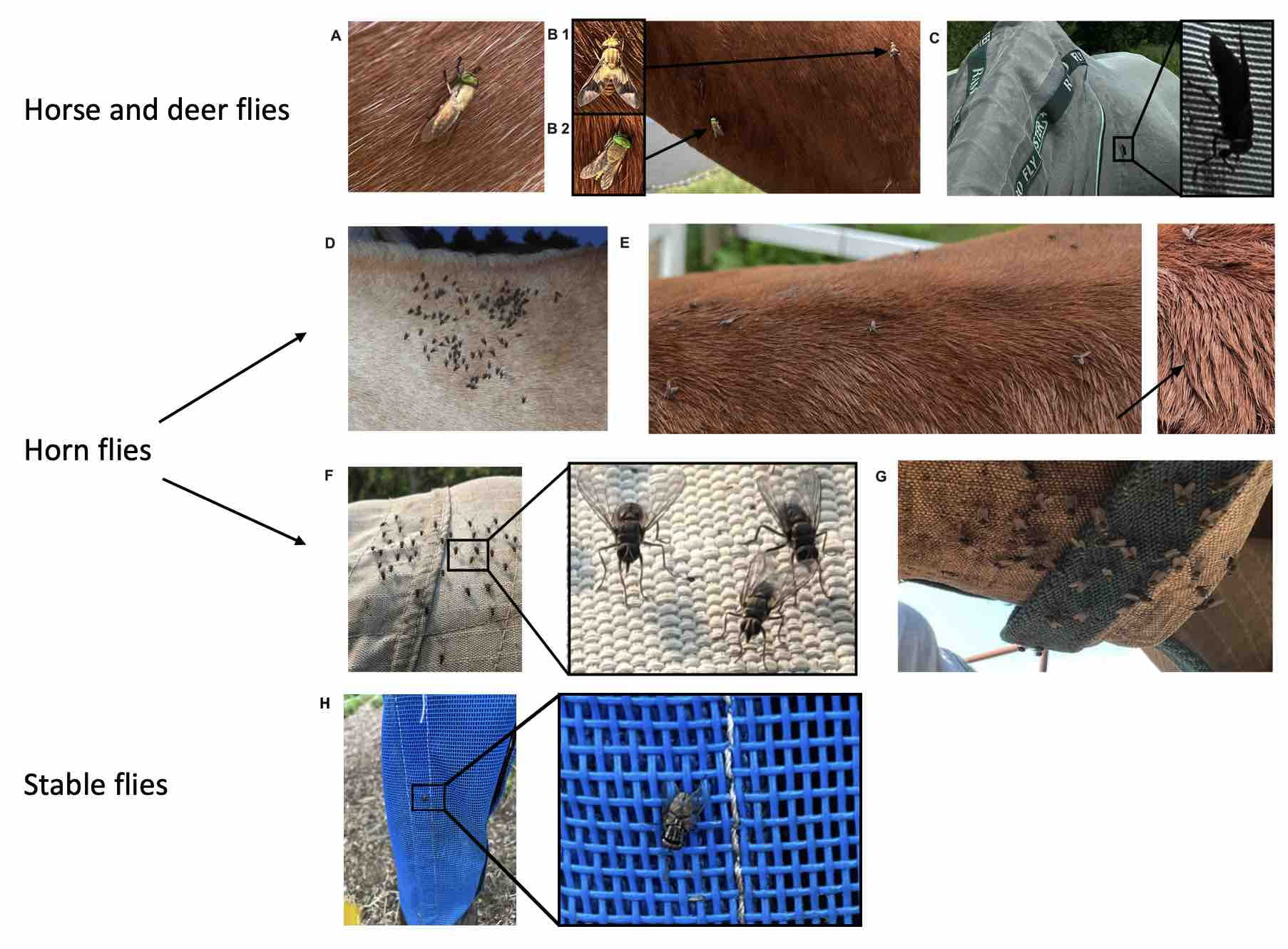
Horse flies (Figure 1 A and B2) and deer flies (Figure 1 B1) both have brightly colored eyes although, the larger black horse fly (Tabanus atratus) (Figure 1 C) can also often be seen. The fly in Figure 1 C was observed trying to feed off a fully covered horse but was unsuccessful and moved onto an uncovered horse nearby where it fed successfully despite attempts from the horse to remove it! Horn flies (Figure 1 D-G) are commonly found on cattle although horses can also be a suitable host. These flies feed 20-30 times a day causing significant fly worry. Horses can often be observed with saliva patches on their back around horn flies (Figure 1 E) indicating repeated attempts to get rid of flies. Horn flies tend to feed together as a group on the neck, withers and belly. Scarring can commonly be seen under the belly in horses with large numbers of flies sustained over a long period. Fly sheets with belly coverings are most effective against horn flies. Stable flies (Figure 1 H) have a strong preference for horse legs, especially front legs. Covering legs though the use of fly boots reduces stamping which can cause stress on the leg and hoof. Best fly protection can be achieved by selecting a well fitted sheet that covers as much of the body as possible (Figure 2). Fly boots come in a variety of types and it is best to select on which can cover as much of the lower leg as possible. Face masks are especially useful in later summer when flies attempt to feed around the horse eye, nose and mouth which can cause irritation and sores. As with all horse gear, check daily for correct fit or signs of rubbing or discomfort!

Figure 2: Example of a well fitted full body fly protection