By Pat Melgares, K-State Research and Extension news service.
MANHATTAN, Kan. — An insect that is showing up in large numbers on sidewalks, under trees and around grassy areas in Kansas is not a major threat to turfgrass—but they are a nuisance, said Kansas State University entomologist Raymond Cloyd.

Green June beetle larvae (grubs) are approximately two inches in length. The larvae are prevalent in large numbers near managed and unmanaged grassy areas. High temperatures and abundant moisture, such as what many parts of Kansas have experienced recently, enhance their presence.
“The larvae are not going to cause substantial damage to your turfgrass,” Cloyd said, “but the larvae are a nuisance.”
At one location near K-State’s Manhattan campus, Cloyd said he collected about 20 larvae from the sidewalk and on the soil in less than three minutes. At the same location, a worker had a bucket containing more than 50 larvae.
Cloyd said green June beetle larvae are common this time of year, but he admits that he has received more email inquiries from Kansas residents about the larvae this year.
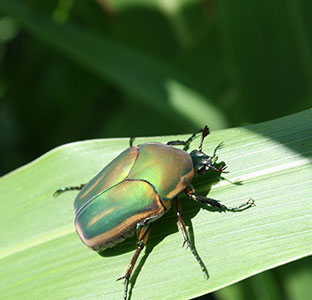
Green June beetle adults are present during the summer months and fly erratically, occasionally bumping into people and objects. When flying, adults produce a sound like bumble bees.
The larvae are present from late summer to early fall, and feed near the soil surface in thatch or on grass clippings. They sometimes can be found in pools, basements and garages. Larvae can be distinguished from other turfgrass insect pests by their tendency to crawl on their backs when moving around.
Green June beetle larvae cause less damage to turfgrass than other insect pests, but they can cause some damage by creating soil mounds. Birds, moles and skunks damage turfgrass when foraging for green June beetle larvae.
Cloyd said it is too late to apply insecticides to manage or kill the larvae, which will eventually move deeper into soil and overwinter as mature larvae.
“The Scoliid wasp, Scolia dubia, is a naturally occurring parasitoid of the green June beetle larvae located in the soil,” Cloyd said. “Females fly just above turfgrass infested with green June beetle larvae. A female locates a green June beetle larva in the soil and uses her ovipositor (egg laying) device to paralyze the larva.”
“If you have large numbers of larvae on your sidewalks or other areas of the yard, you can collect them and place into a container of soapy water to kill them.”
Cloyd has authored a publication titled, Green June Beetle: Insect Pest of Turfgrass, which is available online from the K-State Extension bookstore.
More information also may be available at local extension offices in Kansas.