Kansas State University

search

Extension Entomology

Tag: monarch butterfly

Pollinator Working Group Webinar Series and delay in the Monarch listing final decision

monarch on a flower

Passionate about monarch butterflies? Mercy from the Monarch Joint Venture, Pollinator Working Group lead, shares a few updates as we head into the new year. They have an amazing 2026 planned so stay tuned!

Lunch and Learn Series
They plan to launch a 2026 Lunch and Learn series featuring the Monarch Project Partners and all the great work that Monarch Joint Venture has done together. The sessions will be held every Tuesday starting January 13th at 12 CST. They want this to be a space for Defense staff to discuss issues and lessons learned as well so there will always have time for questions and discussion.

Monarch Radio Tags
The Monarch Defense team deployed the new radio tags in this season. Mercy will be preparing a short overview of the methods, early observations, and lessons learned that may be useful for installations. We hope to have a webinar session focusing on the tags. Here are the articles that discuss the project.

Monarch Listing Decision Update
The U.S. Fish and Wildlife Service has announced a delay in the final Endangered Species Act listing decision for the monarch butterfly. While the species remains a candidate, this extended timeline highlights the importance of continuing proactive conservation and monitoring efforts. For additional context, this AP News article provides a helpful overview of the current delay.

Proposed listing of the monarch butterfly as a threatened species

monarch on a flower

The U.S. Fish and Wildlife Service (FWS) is proposing to list the monarch butterfly as a threatened species under the Endangered Species Act (ESA) in the 48 contiguous states. A threatened listing under the ESA can modify or exempt certain species protections to balance conservation efforts with economic impacts. It allows flexibility to incentivize positive conservation actions. Details about prohibitions and exceptions are available on the FWS website.

Continue reading “Proposed listing of the monarch butterfly as a threatened species”

Look At All the Painted Ladies

–by Dr. Raymond Cloyd

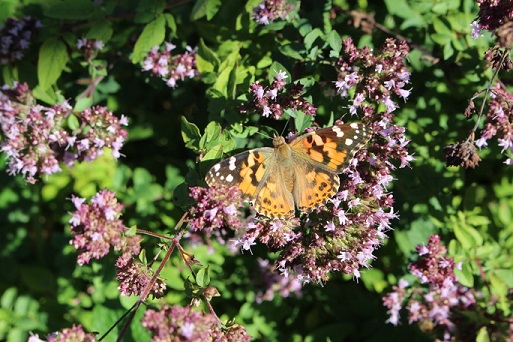
This year, throughout Kansas, we have seen an abundance and wonderful display of painted lady (Vanessa cardui) butterflies. The painted lady butterfly is one of the most common and widely distributed butterflies worldwide. Adults are distinct [and very different looking than the monarch butterfly (Danaus plexippus)] having wings that are mottled brown-yellow, white, brown, and black. There is a row of “small” eyespots on the underside of the hindwings (Figure 1).

Figure 1. Painted Lady Butterfly Adult (Author–Raymond A. Cloyd)

In addition, there is a white crescent on the front edge of the forewing (Figure 2).


Figure 2. Painted Lady Butterfly Adult (Author–Raymond A. Cloyd)


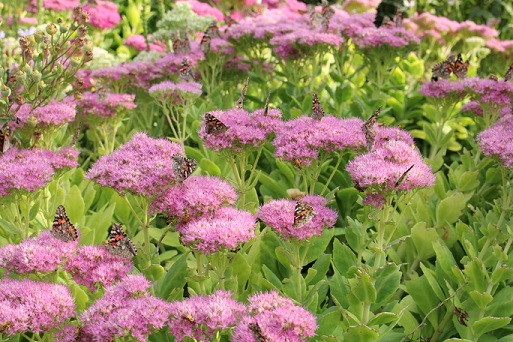
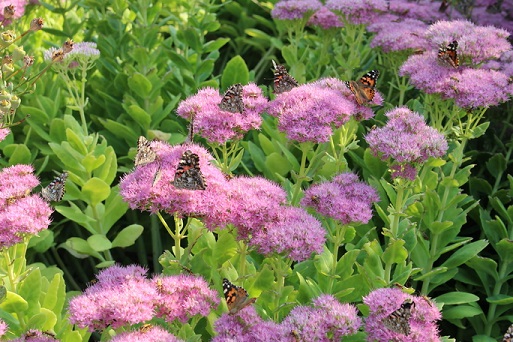
Painted lady adults feed on the nectar of many different plants in flower including sage (Salvia spp.), stonecrop (Sedum spp.) (Figures 3 and 4), butterfly bush (Buddleia spp.), and coneflower (Echinacea spp.).


Figure 3. Painted Lady Butterfly Adults Feeding On Stonecrop (Sedum spp.) Flowers (Author–Raymond A. Cloyd)

Figure 4. Painted Lady Butterfly Adults Feeding On Flowers Of Stonecrop (Sedum spp.) (Author–Raymond A. Cloyd).


The larvae are spiny and feed on the leaves of various plants including sunflower (Helianthus spp.), hollyhock (Alcea rosea), burdock (Arctium spp.), and thistle (Cirsium or Carduus spp.). The painted lady overwinters as an adult; however, most die during the winter (if we have a so-called winter). The painted lady adults migrate northward from the southwest from March through November with two flight periods. In fact, painted lady adults can fly >600 miles. It is possible that the front associated with Hurricane Harvey this year may have “pushed” more adults northward into Kansas. However, this is not the first time Kansas has experienced a plethora of painted lady butterflies. For instance, a migration flight in 1983 was so extensive that butterflies hitting windshields were a hazard to motorists. In addition, a single northward migration contained approximately 3 billion painted lady butterflies. So, just enjoy a wonder of nature…lots of painted lady butterflies.